Friday, September 30, 2022

The Hampstead Prima Donna


The Rev Sherrard Beaumont Burnaby of Hampstead Parish Church was proud of his choir. He'd arrived at St. John's in 1873 and - under the leadership of James Shaw, a young man from Leeds, the choir, "commencing with a few rough boys only" had become celebrated for its "very high state of efficiency." 

All was harmonious in Hampstead until 1879 when the vicar clashed with Elizabeth Tocock, a parishioner of long-standing. (Mrs?) Tocock was in her mid-50's and had been a resident nurse/companion for a wealthy family in Holly Mount. She attended services regularly, morning and evenings. At first, her "incessant and tuneless singing" merely annoyed Rev. Burnaby. The clergyman's discreet emissaries got nowhere and Mrs. Tocock sang even louder and more off-key than heretofore. 

After meetings with his churchwardens, and consulting with the Bishop, Mr. Burnaby took a most unusual step. By ancient law, it was a crime to disrupt a church service; the official term was "brawling." Mrs. Elizabeth Tocock was given a summons to appear in Hampstead Police Court on 3 December 1879 to answer a charge that she had “unlawfully disturbed, vexed, troubled and disquieted” the vicar of St. John’s Parish Church. The Rev. Mr. Burnaby told the magistrates that he, along with the members of his choir, and indeed the greater part of his congregation, had exhausted their patience. “She makes the most shocking noise, which I suppose she would call singing, at the topmost pitch of her voice.” Her antics clearly unsettled the organist and choir as she sang at her own tardy pace. The vicar also pointed out that the nettlesome woman customarily took a seat no more than fifteen feet in front of the pulpit so as to be directly in his vision. The exasperated Mr. Burnaby said no one could conduct themselves in such a manner without intentionally wishing to annoy. 

Mr. Woodd Smith of Hampstead Heath, the local JP, was not an ardent churchgoer but fully sympathized with Mr. Burnaby’s plight. Whether Mrs. Tocock meant to do it or not, the law was plain: any conduct which hinders divine service is unlawful. If it was up to him, he would order her to pay a fine of £5 or spend two months in jail. The vicar had no wish to have "the diva" incarcerated. It was agreed to suspend matters for one month to see if Mrs. Tocock could control herself. As she left court, however, she told reporters, “I cannot worship if I cannot sing.”

The story of “the Hampstead Prima Donna” made all the papers. Mrs. Tocock, described as a “respectably dressed and apparently well-educated woman,” was not without supporters, especially among those who were dubious of elaborate rituals and music during services. A COUNTRY CLERGYMEN, cheered her on, "Dear Madam, I fear at the present time there are many who wish to convert our churches into mere places for hearing singing."

When her case was called again, there was general agreement that Mrs. Tocock was doing her best not to annoy. That must have been the end of it as the cacophonous woman vanishes from the annals of Hampstead lore. Only a few weeks later, 200 members of the London Church Choir Association gathered for a concert at the parish church. Mr. Shaw was at the organ; the programme included Gadesby’s “Not unto us, O Lord.” Mr. Burnaby’s silent prayer, no doubt.

For more tales of "vexed, troubled and disquieted" Victorian clergymen, How the Vicar Came and Went is now available from Amazon.


Tuesday, August 23, 2022

Sins of the Flesh


In 1841, the Bishop of London, the Right Rev. CJ Blomfield, consecrated the new church of St. Peter in de Beauvoir town, a planned suburb for the middle classes in Hackney, two miles north of the City. The prelate was also pleased to announce that the Hon. and Rev. Frederick Smyth Monckton was to be the perpetual curate of the new parish. The young clergyman certainly arrived with much to his favour. Only 30, he'd been ordained after his studies at Christ Church, Oxford. He was also the son of the late 5th and brother of the 6th Viscount Galway.

Rev. Monckton was unmarried and set up his small establishment in the Parsonage House in de Beauvoir square. People will talk, of course, when a young single cleric finds the need to employ three, sometimes more, young and comely female servants. When challenged, he snapped, "Damn, I'll have fifty if I want." The gossip continued; visitors to the parsonage reported the Rev. Monckton was most often to be found below stairs, in the kitchen, surrounded by his "maids," smoking, drinking and singing bawdy songs. Attendance at St. Peter's fell off; in his church that seated 1000 souls, no more than a handful, usually  including the clergyman's aged mother - were present to hear the Rev. Monckton's homily. 

By 1844, the churchwardens notified the bishop who ordered a Diocesan Commission of Inquiry - the first to be held under the new rules of clergy discipline. For several days, before a panel of deans and deacons, witnesses aired their stories about Mr. Monckton, delighting the press which printed full details in lengthy columns. One neighbours, with a commanding view of the parsonage garden, observed a questionable scene. "His female servants were there with him. His demeanour was familiar and indecorous. One of the servants when stooping to weed was not decent, her dress being elevated more than was proper before her master." The lead accusers were Mr. and Mrs. Williams, who had managed the parish school until falling out with Rev. Monckton. They were regular visitors to the parsonage, witnesses to many unseemly outbursts, including the clergyman passed out on the floor. By far, the most serious charge before the panel was fornication. One of the servants, Sarah Huggins, carried herself as "the lady of the house" in finery far above her station. The previous year, Miss Huggins had taken a "holiday," when - it was alleged and she did not deny - she gave birth to stillborn twins. The Rev. Monckton was identified as the "gentleman" who visited her frequently during her confinement.

Under the rules of the day, the Rev. Monckton could not testify. His lawyer labeled the charges an atrocious conspiracy; false and calumnious accusations led by the vengeful Williams' and others with ceaseless malevolence. Even Monckton's supporting witnesses conceded that life at the parsonage might be considered too rollicking for some but it was all in good fun. Nothing improper had taken place between the clergyman and his household. As for Sarah Huggins, she assured the panel Mr. Monckton was not the father of her two dead babies. She blamed a "seafaring man" she'd known only briefly. 

The commissioners took time to consider the evidence; the verdict was delivered by Dr. Lushington, the Vicar-General. They found no convincing evidence that Rev. Monckton was guilty of fornication or that he had taken any indecent liberties with "divers women." A charge of drunkenness also failed. However, "the conduct of Mr. Monckton with regard to the females residing in his family, and especially with regard to Sarah Huggins, was degrading to him as a clergyman of the Church of England, and had produced great scandal in the church." They would recommend to the bishop that some action be taken. 

Rev. Monckton was suspended for twelve months from 1 June 1845. Some thought the censure was too light. "A clergyman undoubtedly possesses some privileges; but these can never be supposed to extend to taking a brace of young girls on his knees, continually smoking cigars in their society, laying hold of them in an indecent manner, getting roaring drunk and singing bawdy songs, and indulging habitually in ribaldry and obscene language." 

The accused never resumed his duties in de Beauvoir town. His name disappeared from the annual clergy lists. He was just 50 when he died at Bath in May 1861, still identified as the the Hon. and Rev. Frederick Smyth Monckton.

How the Vicar Came and Went, a collection of Victorian clerical scandals, is now available at Amazon.  


Wednesday, July 27, 2022

The Black Sheep of Chipping Warden


(chippingwarden.org)

 Not far from Banbury, just over the   Oxfordshire border in Northants, lies   the quiet, "pleasantly situated" village   of Chipping Warden. On the village   green, visitors will find the splendid   medieval Church of Saints Peter and   Paul. For the last decade of the   Victorian period, the rector there - the Rev. Edward Henville M.A. - was denounced by his own bishops, and publicly labeled a disgrace to the Church of England. 

Henville's exact antecedents were shrouded in some mystery. He claimed to be a graduate of Trinity College, Dublin. He also claimed to have been ordained while out in India but he refused to name the Indian Bishop who admitted him to holy orders "for reasons of my own." Back in England, he spent several years as a curate before serving as vicar of Shelland & Gipping, impoverished rural parishes in Suffolk. There, he first drew attention for his "begging-letters." He pestered his wealthy correspondents with the pathetic story of a poor cleric unable to support his wife and ten children. The Bishop of Peterborough was moved to assure the public that Henville's story was highly embellished and to please ignore his letters. 

In 1889, Henville finally left East Anglia (and numerous unpaid tradesmen behind) for Chipping Warden. The Lord of the Manor in Chipping Warden was a Catholic and could not have anything to do with the village church. The living, therefore, was for sale. The laws of simony prevented a clergyman from buying his own church but Henville got around that through the generosity of a "Miss Henville of Stanton Hall, Lincoln." (A fine lady - if she existed at all.) There were no other bidders and Henville became rector of Chipping Warden, which came with about £200 a year, a commodious rectory and more than 100 acres of glebe land. 

Notwithstanding his elevated status, Henville's "impudent appeals" continued. Certainly, he was not the only practitioner of the scheme but few had such a system. His letters were professionally lithographed, making them, in effect, early spam. The letters were always the same. His eldest son was "hopelessly insane," the younger was (supposedly) maimed in a shooting accident. The rector asserted he'd been swindled and mistreated by the grandees of the Church of England. He could hardly support his eight daughters. In 1896, one of his unmarried daughters, at the age of 30, delivered a stillborn baby in the Chipping Warden rectory. The "sad affair" and ensuing public inquest added a new scandal to Henville's career. In fact, the rector monetised his daughter's shame by simply appending her plight to his printed list of grievances. 

Henry Labouchere, the editor of the Society weekly, Truth, had a special obsession with begging-letter writers. He singled Rev. Henville out as the worst of them all. "Here is a man who has for many years made a trade of writing lying appeals to wealthy ladies and others likely to be moved by a pathetic story of a starving parish priest. His true character is well known among his parishioners and among his neighbours. What scandal can be more shocking than the spectacle of such a man performing week by week the most sacred functions in the pulpit and at the altar?" That church superiors were unable to remove the "reverend mendicant [was] a scandal of the worst kind." It was Labouchere who dubbed Henville the "Black Sheep of Chipping Warden."

Only a week or so before Queen Victoria's death in 1901 ended her long reign, the Rev. Edward Henville died in his rectory. He was 60. He was replaced by the Rev Stephen Cartwright, son of a local baronet. The announcements noted that Chipping Warden parish had been "so long discredited by the incumbency of the late Rev. E. Henville."


Rev. Henville was not the only begging-letter writing clergyman. The Rev. Richard Marsh Watson, however, combined his money-raising schemes with a bit of blackmail. For more, see my book Clerical Errors: A Victorian Series, Volume Two. Thank you very much indeed.


Tuesday, June 28, 2022

"It's only me, Emma. I won't hurt you."

St. Swithin's, Wellow (geograph.org)
A modern guide book describes the small Notts village of Wellow as "chocolate-box pretty, an idyllic vision of rural England." The maypole on the village green is the tallest in England. The 12th century church of St. Swithin's welcomed a new vicar in 1858; the Rev Jermyn Patrick Royle, with his wife and four children, arrived in Wellow and settled in the vicarage over the road. 

Late in 1861, 17 year old Emma Ward, the servant at the vicarage, asked Mrs. Royle if she could go to the Wellow fete to watch the cricket on the green. Whether Mrs. Royle instructed Emma to come right home after the match or not, Emma went along to the Durham Ox (now the Maypole) with some friends where she danced and talked of the day's events, not returning until quite late. Mrs. Royle was not pleased and gave the girl her notice. To which, Emma saucily replied, "It's for the best. I better leave before my character is gone.”

Emma's eventual story varied in each re-telling. A few weeks before the fete - Mrs. Royle took her three daughters to London for a short visit. Emma remained at the vicarage with Rev. Royle and his young son. According to Emma, Mrs. Royle's carriage wasn't even out of sight before the vicar suggested he'd come into her bed that night for a roll-about. Thinking it was just a ribald jest, Emma did her chores, locked up the house and brought the keys to the vicar's study and went up to her room. The door could only be loosely fastened. That night, she awoke to find the 47-year old vicar in her bed. 

The vicar - of course - denied it all. But the story got round and church attendance in Wellow began to decline. The churchwardens did some digging, visiting the vicarage to inspect the bedroom layout. The Bishop of Lincoln was informed of the "disgusting" claims against their vicar. The bishop demanded that Royle, if he was innocent as he claimed, must prosecute his young accuser for slander.

For two days at the Notts Assizes in March 1862, it was "he said, she said." As for the vicar, he insisted that he remained in his study until he went to bed that night at 11:30, keeping to his bedroom - alone - until morning. Under cross examination, he denied a servant at one of his previous churches left his employ "in the family way." The presiding judge also declined to allow into evidence a letter from another servant. Still, it was published in one of the local papers. The woman asserted she had been subjected to similar molestation and Mr. Royle deserved to be exposed. [Lastly, while researching this case, I learned that Mr. Royle, as a young student at Cambridge, was "rusticated for being in the habit of continually visiting the house of a prostitute." (Linehan, St. John's College Cambridge, A History)]

Emma Ward spent several hours in the witness box. She was sharply questioned. She admitted staying in the vicarage for several days after the alleged incident, telling no one, and only made her charges after she was let go by Mrs. Royle. Emma's testimony was frequently interrupted by laughter. When the vicar slipped into her bed, she recalled him saying, "It's only me, Emma. I won't hurt you." As noted, her story varied: to some, she said she struggled free from the vicar but, to others, she said "he had connexion with me."

Rev Royle's counsel tore apart the inconsistencies in Emma's stories. Her charges were completely uncorroborated. Emma's lawyer, meantime, insisted she was a "good" girl whose basic account of what happened in the vicarage bedroom remained unshaken. Connexion wasn't required. The shocking liberties taken with a young girl under the vicarage roof were proof enough. The jury of twelve men spent less than an hour to find Emma Ward had slandered Mr. Royle but they expressed their opinion of the reputation of the vicar of Wellow by awarding him damages in the insulting amount of one shilling

Police had to protect the Royles who were "jostled rather roughly" as they left the courthouse. The Rev. Mr. Royle returned to his vicarage; in fact, he remained many more years at St Swithin's until his death in 1885. The parish history records that, during Royle's time in Wellow, the church fell into considerable disrepair. At his death, however, he was remembered as an excellent preacher, "even the children could follow his beautiful discourses."

How the Vicar Came and Went, a collection of Victorian clerical scandals is available at Amazon.

Tuesday, May 31, 2022

A Jubilee Scandal

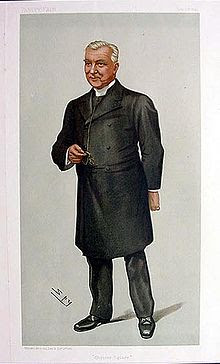
Canon Fleming
(Vanity Fair)

The anticipation for Queen Victoria's 50th Jubilee, being celebrated in June of 1887, would have seemed familiar to us. The stores were filled with Jubilee flags, brooches, soaps, plates, and framed photographs of Her Majesty for the mantel. For the more devout subjects, one of her favorite chaplains, the Rev. Canon James Fleming, published a small reprint of two recent sermons at St. Michael's, Chester Square, the posh London church where he had been vicar for many years. 

There was a belief in the book world that no one ever reads published sermons. Not in this case as Canon Fleming was soon publicly accused of gross plagiarism. An embarrassing pamphlet made the rounds: "The Stolen Sermon, or Canon Fleming's Theft." Side by side comparisons made it plain that Fleming had copied directly from a sermon given by the American evangelist T Dewitt Talmage of the Brooklyn Tabernacle. Talmage was a Presbyterian, and. a religious celebrity in America known for his "dramatic physical theatrics." During a London visit in 1877, huge crowds came to hear (and see) him preach in Hyde Park and elsewhere. Talmage even met Rev Fleming at that time and found him to be a "most agreeable" gentleman. 

Rev T Dewitt Talmage
(1832-1902)
Ten years later, in Brooklyn, when informed that the gentleman Canon had almost certainly stolen his sermons, Talmadge was quite gracious. Such a "friendly, genial, glorious man" wouldn't be capable of the charge made against him. In London, Fleming confessed that he had read Talmage's sermon in a published collection, Fifty Sermons (now to be found on line at forgottenbooks.com). It obviously made a great impact on him and he copied it out. When referring back to those notes, the canon believed he unconsciously presumed it to be his own work. Critics called the explanation of "unconscious cerebration" worse than the crime. The Pall Mall Gazette asserted that "no apology" could explain the "word for word, sentence for sentence, striking thought for striking thought" theft of another man's sermon. A New York paper said the matter raises "an uncomfortable doubt as to the English canon's moral condition." 

Fleming survived the kerfuffle, for he was "altogether a good fellow" and a royal favorite. But, the scandal was recalled at his death in 1908. "He will not be comfortable when he sees Talmage coming his way across the Elysian fields."

Monday, May 9, 2022

She Absolutely Refused To Live With Me


Sion College Library*

William Henry Milman was born in 1825. He grew up in cathedral surroundings. His father was one of the great Victorian Deans of St Paul’s. William went to Oxford to study for the clergy but seems to have been more noted as a champion oarsman. It was also at university that Milman first evidenced his “wide yet discerning appreciation for books.”
 

Ordained in the 1850’s, and benefiting from his father’s patronage, he was given the ancient church of St. Augustine & St. Faith on Watling Street in the City. But his greatest service to the church came as chief librarian for Sion College, overseeing a collection of 70,000 clerical books. Milman spent many years cataloging the books, developing his own system. He also prevailed upon the church to relocate the library from its inconvenient and inaccessible location in London Wall to a "more central position nearer to the West End.” 

The move to the Embankment was underway when, on 13 December 1884, Rev. Milman was married. Now a Minor Canon at St. Paul’s, Milman was 59 on his wedding day. His bride was just 23. Margaret Julia Campbell was a daughter of Sir George Campbell. After several years as an administrator in the Raj, Campbell returned to London, was elected to the House of Commons, and soon known as a great bore, offering “dismal orations on every possible subject.” The Campbells were South Kensington neighbours of the longtime bachelor bookman. Their wedding at St. Jude’s drew a “large and fashionable congregation” and the father of the bride gave a wedding breakfast for 800 people in Southwell Gardens. The curious couple left for a Paris honeymoon: Canon Milman in clerical black, his young wife sporting a red tam-o-shanter bonnet.

Only a few months later, a brief comment appeared in the weekly Truth: "The marriage of a well-known London clergyman which excited a good deal of interest in some sections of 'Society' last winter, has not proved a success, for incompatibility of temper has led to such very strained relations, that the lady has returned to her father's house."

The Milmans never lived together again. He returned quietly to the thousands of volumes to be sorted at the new Sion Library. “Mrs. Milman” made a stir in the “Spirit World” claiming she and her sister had “Coincidental Hallucinations” of seeing their mother writing letters in the library when the lady was actually upstairs in her bedroom all the time. This inexplicable event excited great interest in the Psychical Research journals. 

So it went for many years. "Unhappy couples were expected to put up with it, quietly arranging their lives to live apart if necessary." (Frances Osborne, The Bolter). But, in 1896, eleven years after they separated, the Canon received a letter from his wife. "The only straightforward and honorable course is to let you know that I have formed an attachment to one that has become everything to me. I am anxious to avoid all unnecessary publicity in the affair." The canon filed for divorce; he admitted his wife “who was of a very peculiar tone of mind,” declared that she could not live with him under any circumstances. Incompatibility alone was not enough. The usual private enquiry agent was employed to watch the movements of Mrs. Milman and a young solicitor named Murray (his actual name was Edward Sieveking.) They were discovered living as husband and wife at a hotel in Dover and in the Rue de Louvre in Paris. Mrs. Milman, of course, made no effort to defend her adulterous conduct. The divorce was granted and within months she and Sieveking were married.

Canon Milman died in 1908, to be remembered as a zealous and highly qualified librarian, a most amiable and good-natured man, who amply deserved the recognition of his brethren. There was no mention of his brief marriage. The temptation is to compare him to Edward Casuabon from George Eliot’s Middlemarch, that dry bookman who rejected “the preposterous demand that a man should think as much about his own qualifications for making a charming girl happy as he thinks of hers for making himself happy.”

How the Vicar Came and Went, a collection of clerical scandals, is now available at Amazon.

Illustration: MonumentofFame.org

Monday, April 4, 2022

A Railway Outrage or a Joke?


The Rev John Robert Kennedy Bell, just past 40, married with three children, was typical of the hundreds of “poor curates” – scouring the English countryside, literally begging for preferment, however temporary.  In 1892, he was employed as a locum tenens in Little Bedwyn, a Wiltshire village bordering Berks. 

On the evening of Thursday, May 12, the Rev. Bell was returning from Newbury to Bedwyn via the Great Western’s night train. At the stop in Hungerford, 16-year old Fanny Abery, - who worked at the Hungerford post office – came aboard the third class carriage returning home to Bedwyn. By some prior arrangement, she was supposed to have brought along Mr. Bell’s mail which she admitted she'd forgotten.  Rev. Bell never denied that he called her a “naughty girl” and – as a joke – said he would put her over his knee and “smack her.” Fanny was not having any of it, joke or not. At Bedwyn station, she reported the clergyman assaulted her. She claimed he pulled her on to his lap, tried to kiss her and assaulted her. The Rev. Bell was later arrested on a charge of indecent assault.  When taken to the Hungerford nick, he explained the girl had over-reacted; he'd been just “having a joke.” 

In Police Court, Fanny told her story again. They were alone in the carriage. From Hungerford to Bedwyn took eight minutes and she struggled with the Rev. Bell for about half that time. John Taylor, the Bedwyn station manager, recalled she made the report to him but he didn't think Fanny seemed unduly upset. When the girl's mother later came to complain, he turned it over to the police. The clergyman’s lawyer called it the mistaken testimony of a hysterical girl. She had no injuries, no marks, and no tears in her dress. The case had drawn great attention in the area and a second young lady (16-year old Kate Britton) had come forward. On that same night, on that same train, in Kintbury, she also had to fend off an amorous clergyman.  The Hungerford magistrates ordered Bell be kept six weeks in jail awaiting the Berkshire Quarter-Sessions.

The trial was held in Reading in late June; the second charge was never prosecuted, only Fanny Abery’s testimony was heard. The "tall, nice-looking girl" again detailed the alleged assault and ensuing struggle. After reporting it at the station, she ran home in tears and missed the next two days of work.  Arthur Spokes, Bell’s counsel, attacked Fanny’s credibility. She had, he claimed, a “flirty” reputation and Rev. Bell had cautioned her earlier about her “boyfriends.” There were also discrepancies in Fanny’s account, from the two court appearances some weeks apart. Alice Martin, another village girl, saw Fanny that night and her friend made no mention of any problem with Mr. Bell.  Alice noticed nothing unusual in Fanny’s behavior. 

Spokes, opening his defense of the Rev. Bell, praised the clergyman’s “pure and unsullied character.” He called the usual character witnesses, including Mrs. Bell, who described the curate as “the purest man that anyone could have for a husband.”  Spokes insisted a clergyman was due to be believed over a frivolous girl making a "reckless charge.” The jurymen made very quick work of the charge, finding the Rev. Bell not guilty.  The decision was greeted with a smattering of applause.  

Despite his acquittal, Mr. Bell’s stay in Little Bedwyn was over. The verdict did not remove the cloud over his name. Bell became obsessed with the newspaper coverage of his trial.  Most of the papers reported Bell had been charged with “assaulting two young ladies.” He had been branded a serial profligate. He sent letters demanding retractions; even the mighty Times published an apology. Bell wasn’t satisfied and sued the Times and numerous other papers. At that trial, new evidence was introduced that Rev. Bell was seen drinking in Newbury before boarding the Bedwyn train. The man insisted, however, he was not drunk that night. In the end, he won his case but at what cost? The newspapers were required to pay damages of --- 40 shillings each.  

The Rev. John Robert Kennedy Bell was adjudged a bankrupt in October 1893.  Assisted, supposedly, by the Bishop of London, Bell crossed the Atlantic, spending several years as an Episcopal clergyman in Canada and upstate New York. He returned to the U.K. and died in Surrey in 1908.

How the Vicar Came and Went, the latest collection of tales of clerical scandals, is now available at Amazon.