Saturday, March 27, 2021

"Meet me tonight"


There is "no other place in the kingdom" such as "the Rows" of Yarmouth, declared Henry Manship in his history of the coastal town. Running east-west, from the River Yare toward the North Sea, resembling a gridiron, the 145 narrow rows were home to hundreds of sea-faring folk and the "general poor." In 1840, Ann Laws resided there, in Row 99, sometimes known as Castle Row. She lived with her husband James, a sailmaker. 

Ann had been to the market on a July Saturday and when she returned home, she found in her basket, a note. “Meet me tonight about nine or half-past-nine between Penrice’s and the beach.” The note was unsigned and unaddressed; she had no idea who placed it in her basket or when. She showed it to James and he bid her to keep that appointment whilst he kept himself some little distance away. 

The Penrice Arms was at the end of Row 99, on King Street. That summer night, the Yarmouth streets and rows were full. Mrs. Laws, in her bonnet, followed the note's instructions. At the approximate hour, she was approached by no less a figure than the Rev Mark Waters of St. George's, King Street. He spoke to her for several minutes but her husband was not able to hear over the general activity in the area. Mrs. Laws, however, told her spouse that she had indignantly rejected the clergyman's indecent requests. 

The Rev. Waters was 34, born in Yarmouth, married and with a young family. His church, St. George's, held more than 1000 souls. Thus, this little story that spread through the rows would not go away. It soon reached the ears of the Bishop of Norwich. The Rev. Waters did not deny speaking to Mrs. Laws that evening but nothing else she stated was true. There was considerable interest, of course, and Mr. Waters was the subject of ribald abuse in some Yarmouth quarters. At last, the following April, an ecclesiastical inquiry was held before three clergyman to determine whether Mr. Waters had "solicited the chastity" of Ann Laws. 

This churchly probe was held in an old inn, The Bear, in Southtown. The accused was not permitted to speak in his own defense. The belief being, that in such a case, even a clergyman would be tempted to lie. Mrs. and Mr. Laws were closely questioned. She spoke of finding the note in her basket and the plan she and her husband conceived to discover the sender. She was shaken to find out it was a clergyman. She told the churchmen she did not know Rev Waters, had never met him in her life. But her own elderly mother contradicted her. In fact, all the evidence was of “a very conflicting and contradictory character.” Several of their neighbours from the Rows spoke diffidently of the accusers' characters.

The numerous press accounts did not include any details on the improper proposals Mr. Waters allegedly made to Ann Laws. Why did she deny knowing him? Had they met before? There was no published suggestion that Mr. Laws had tried to entrap or blackmail the clergyman. Mr. Laws insisted he acted only after his wife had been insulted. The proceedings were lengthy, the meeting room filled with locals of the first rank and numerous clergy. In the end, the empaneled clergymen met privately for one hour, then issued their statement: Although the inquiry found the clergyman’s conduct “highly objectionable," the evidence was insufficient to send the matter to the Bishop for a full consistory court. 


Despite the rather mixed decision, the Rev Mr. Waters left the Bear, cheered by his many supporters. The verdict was generally accepted, having "effectively changed the impression" of Mr. Waters' in Yarmouth. He remained at St. George's until his death in 1864. The old church is now a theatre.

The newly published collection of stories, How the Vicar Came and Went, is now available from Amazon.

Saturday, March 6, 2021

The Rector's Round from The Half Moon


In December 1885, PC Frank Scarterfield of the Surrey Constabulary spent a long cold night - and morning - in the remote village of Charlwood. "Embosomed in the woods," reached only by occasionally impassable lanes, Charlwood was normally a quiet place. The beautiful 11th Century church of St. Nicholas stood in the center of the village with a large rectory, then occupied by the Rev. Edward McFarlane Gibson. Right over The Street was the old public house, The Half Moon.


With much to do on a Sabbath morning, the Rev. Mr Gibson retired at 11 p.m. on Saturday, 12 December. Just about that time, last calls having been served, The Half Moon emptied out into the darkness. There had been a proper "knees up" that night, indeed. The raucous crowd stumbled about, mostly merry, but there were a few scuffles. PC Scarterfield, who policed these bosky lanes with his faithful collie, tried to shepherd the legless lot home. Without success and the PC heard enough backtalk that eventually 8 men were summonsed for being drunk and disorderly, including the publican, Fred Brown.


Even in 1885, there was a lot of paperwork when eight men were nicked. The sun was up by the time the constable thought he might get to his own bed. Then, just past 8:00, on a Sunday morning, he saw a young maid from The Half Moon scuttling over the road to the rectory lugging a large sack, in which the sharp-eared PC heard the unmistakable clink of bottles. He ordered the lass to stop and open her pack - a quick look inside revealed six of the familiar red triangles of Bass Ale. She said the rector had ordered a case of ale but she would have to make two trips. Brown, the hungover publican, was awakened and handed a new summons: selling liquor at unauthorised hours other than to bonafide travelers.


At the Surrey Petty Sessions in Reigate, the Rev. Mr. Gibson appeared in defense of Mr. Brown. The rector said he had ordered the beer and paid for it on Saturday. But it was a boisterous day in the pub and they had forgotten to deliver the case. Mrs. Brown, up early Sunday to get the inn back in order, saw the case behind the bar and sent the girl over with it straightaway. The magistrates, to their great credit, took the word of a clerk in holy orders and the charge was dismissed. They even scolded PC Scarterfield for his "injudiciousness" in bringing such a charge.


Two weeks later, in the same courtroom, the Rev. Gibson was back on the stand. He testified that on that Saturday night he'd been in bed just over the road from The Half Moon and did not really hear the drunken disturbance for which the eight Charlwood men were in the dock. Questioned by the PC, the rector admitted that some of the hedges in the churchyard had been damaged. There was a red spill, probably wine, on the footpath. He had no idea how any of it happened and again he'd slept through most of it anyway. It was another disappointing day for the constable; it wasn't quite as bad as he'd portrayed it. "The Charlwood Eight" were fined 10s apiece. 


Geograph.Org.UK

Charlwood isn't such a quiet place today, not a mile or two from the runways at Gatwick. (Some of the ancient Gatwycks still live in the area.) The Half Moon remains, a "hidden gem" according to one of the pub guides. The Rev Gibson was rector at St. Nicholas until his death in 1913. Surely, he enjoyed a Bass or two at the local. 

Thanks for visiting the blog and consider my new collection, How the Vicar Came and Went, on sale at amazon.co.uk.


Saturday, February 13, 2021

Gypsy, Soldier, Sailor, Surgeon and now a Clergyman


Ten year old Mary Ann Gladwell was a thatcher's daughter in Rattlesden, Suffolk. To help the family, she worked in a farmer's wheatfield. One day in March 1838, she came home complaining of pain in her knee and ankle. There also lived in Rattlesden the Rev John Heigham Steggall, a curious clergyman, the perpetual curate at nearby All Saints church in Great Ashfield. 

Steggall kept a "little shop" in Rattlesden where he practiced a bit of medicine, pulling teeth, midwifery and the like. He'd picked up the knowledge as a boy on whaling ships and in India. Steggall examined Mary Ann and diagnosed her pains as the result of a fractured ankle which he "violently" reset. Then, using the two hard covers from a Bible as splints, he wrapped her ankle in wet calico. 

The girl did not improve. Her parents became quite concerned. Removing the Bible pieces, Steggall discovered large blisters which he pricked and drained "a teacup full." He prepared various poultices - including one of bread and turnips. The Gladwells eventually took their daughter to see Mr. White, a surgeon in Gedding who determined there was nothing for it but to amputate the leg at the knee. Surgeons in Stowmarket carried it out.

At the 1839 Lenten Assizes in Ipswich, the Gladwells sued the Rev Steggall for malpractice resulting in the loss of their child's income. The jury heard the history of poor Mary Anne's leg. She came to court on her "stilts", of course. A surgeon who had examined the child's limb after the surgery said there was never a fracture. He produced the bones for all to see. The doctor testified that there was infection in the ankle that had ulcerated; Steggall had displayed gross ignorance. 

The medical profession of Suffolk was well aware of the 50-year old Steggall's "practice" and there had been a lively controversy predating this "unfortunate calamity." Steggall's lawyer said his client had done his best but professional jealousy was behind the lawsuit. He also accused Mary Anne's parents of a "mercenary and vile" attempt to profit from their daughter's injury. The jury disagreed and quickly returned a verdict for the parents with damages of £10. 


Steggall remained a legendary character in the area, helped by his biography, published in 1856, The Suffolk Gipsy. Containing the Real History of John H. Steggall, Who Has Been a Gipsy, a Sailor, a Soldier, a Surgeon, and is Now a Clergyman of the Church of England.

Speaking of books, the new collection of Victorian clerical scandals, How the Vicar Came and Went, is available exclusively from Amazon. Thank you.

Thursday, January 14, 2021

A Rector's Perambulation in Regent Street


Just after midnight on a cold January evening in 1872, a pair of London constables began following two gentlemen who appeared to be touring the "public conveniences" of Regent Street. They shadowed the pair as they made their way through Burlington Mews, Heddon Street, Vine Street, Swallow Street, and Glasshouse Street. After some little time on the tour, the constables decided to arrest the men for "frequenting public urinals for an unlawful purpose." At the Great Marlbourough Street magistrates court, the lead officer justified his suspicions because one of the men, residing in Manchester Square, was a "known frequenter." The public was much more concerned to learn the second gentleman nicked that morning was the Rev. William Dawson MA, the recently arrived rector of St John's, Clerkenwell. 

The "Extraordinary Charge Against a Clergyman" was heard several days later by which time Mr Dawson had employed counsel who came to court with an impressive collection of testimonials as to the character of his client. The rector of Clerkenwell was 36, unmarried, new to London,  and eager to explore. He brought with him to the great city his "country habit" of talking nocturnal walks. While the alleys off Regent Street were less leafy and wholesome than the lanes of Suffolk, a man must take his walks as he finds them. In no way was he associated with or in the company of the other gentleman, a man he did not know. The magistrate was then presented with effusive statements from the Bishop of Carlisle, Lord Hatherly - the patron of Clerkenwell - and numerous other clergymen, united in their opinion that Mr. Dawson was a man of "saintly purity." 

The policemen held to their stories. They were sure of what they had seen; although the details were reserved as unfit for publication. Under firm questioning, however, "little discrepancies" in their accounts were revealed. Mr. Knox, the magistrate, called it one of the most painful cases to ever come before him. That said, and with no imputations intended against the watchers of the night, Knox was going to release the Rev. Mr. Dawson. The police must have misread his conduct on the night in question. Given the character references, there seemed to be no way the clergyman could have been involved in the horrid actions alleged.

The Rev Mr. Dawson remained at St John's for more than two decades and authored a history of the parish in 1891. By far a more celebrated story from Clerkenwell involved the Rev. Robert Maguire of St James who was accused of grossly insulting a young woman in a railway carriage. You can read about "The Clergyman's Wayward Foot" in my new collection of Victorian clerical scandals, How the Vicar Came and Went, available NOW.


Saturday, November 28, 2020

A book for a Victorian Christmas £7.99


HOW THE VICAR

CAME AND WENT

Victorian Clerical Errors: A Collection

By Tom Hughes


Available NOW and exclusively through Amazon.co.uk 


The vast majority of Victorian vicars, rectors and curates - not to mention the loftier prebendaries, deans and canons - led blameless lives of devoted service to their congregations whether in crowded cities or the most remote corners of the island. They were kind and true to their wives. In their quiet hours, they busied themselves with their bees, books and bells. At their passing, they were much lamented; a few were even worthy of a memorial window.

This little volume, however, recounts the stories of 30 clergymen, accused - and sometimes falsely accused - of crimes and failings, large and small. The headline, "A Clergyman in the Dock," never failed to sell newspapers. “It is wonderful the interest that is taken in the peccadilloes and sins of the cloth and were it the custom to charge admission into our law courts, on such occasions, I am satisfied that the prices might be doubled when a clergyman is the defendant.”

Table of Contents:

  • HOW THE VICAR CAME AND WENT
  • THE GREAT GLOUCESTERSHIRE HEN CASE
  • CHARLES DARWIN AND THE CURATE
  • “I MET A VICAR SPRUCE AND GAY”
  • A TUTOR OF YOUR BASTARDS
  • A HAMPTON COURT SCANDAL
  • A CLERGYMAN WANTING IN “ORDINARY HUMANITY”
  • THE VICAR AND HIS HOUSEMAID
  • AN EXTREMELY HEART-RENDING CASE OF SEDUCTION
  • OUR MARRIAGE HAS BEEN A MISTAKE
  • VILE MACHINATIONS
  • OPIUM WASHED DOWN WITH WINE
  • A BIT DESPOTIC
  • A CRUEL AND HEARTLESS VILLAIN
  • SO SQUALID A SCANDAL
  • AN OUTRAGE TO SOCIETY
  • A CLERGYMAN’S WAYWARD FOOT
  • THE PRODIGAL FATHER
  • A BESIEGED CLERGYMAN
  • THE BLACKEST CRIMINAL I HAVE EVER SEEN
  • IN A VICARAGE FOR “IMMORAL PURPOSES”
  • NO PEACE IN FYFIELD
  • A CURATE IN THE FOOTLIGHTS
  • THE PARSON’S LADY FRIEND
  • THE TORMARTON MENAGERIE

ABOUT THE AUTHOR: Tom Hughes is (to his knowledge) not related to the Rev. Thomas Hughes, the bigamous Victorian clergyman denounced from the bench as the “blackest criminal” of the day. The story of the Rev. Mr. Hughes and the other clerics in this book have been culled from an unrivalled database of clerical scandals and sensations.

Contact: victorianga@aol.com

The collection includes stories from Birmingham, £££Brentford, Bristol, Cheltenham, Derby, Downe, Ealing, Eastleach Martin, Fyfield, Germansweek, Hampton-in-Arden, Hereford, Leeds, Manchester, Semer, Slough, Syde, West Haddon, Wilmington, and, of course, London.

Previously published:

Blame it on the Devon Vicar (Halsgrove 2008); Blame it on the Norfolk Vicar (Halsgrove 2008)

Clerical Errors, A Victorian Series - Vol. 1 (Amazon, 2016); Vol. 2 (Amazon, 2017)


Saturday, November 7, 2020

I Met a Vicar Spruce and Gay


Birmingham's New St Station (wikipedia)

In 1855, the "infamous Alice Grey" fascinated the English public. A charming con-woman, she could be found weeping in railroad stations or hotel lobbies. "Her trunks and purses were constantly being stolen, leaving her stranded without a penny." She cadged money, train tickets, meals, and perhaps more. "Her pretty face, her white skin, delicate colour, and soft voice, were great assistants to her pitiable tales." Numerous men admitted to being gulled by her in a trail that crossed Scotland and England. The most embarrassing case was surely that of the Rev. Joseph Ashby Morris, vicar of Hampton-in-Arden, near Birmingham.


In October, Alice was arrested in Wolverhampton. Her story was that a man she met in Birmingham gave her £4 and told her to take a room in Wolverhampton where he'd visit her. In Birmingham, police recalled a woman matching her description walking from the station with a gentleman. The story got more interesting when the generous gentleman was found to be a clergyman, the Rev. Mr. Morris. 

Before the magistrates and a large crowd, Alice told her story. She met the vicar at Birmingham station with her usual story: her cases and purse were missing and she needed to get to Liverpool. Since there was time, he offered her a meal. Alice said he took her to a coffee-house, ordered brandy and became quite amorous, to the point they were asked to leave. They moved on to a spirit shop where they each had three glasses of wine. The Liverpool train was due so he gave her the £4 and arranged to meet in Wolverhampton. 

The Rev. Morris was 55, married and had been at St. Mary & St Bart's in Hampton since 1841. He was in court, with his wife, and heard Alice's evidence. He took the stand to "indignantly" deny all. He did meet her in Birmingham, weeping with a tale of stolen bags. "Out of compassion," the vicar swore, he took her to a temperance coffee house for tea and ham, no more. When she appeared ready to faint, he called for brandy. He had no spirits that evening. The landlady did ask them to leave because the room was needed for a meeting. Alice was allowed to question the witness. Didn't he talk of 9000 kisses? He never said that. Alice claimed the landlady was disgusted by their behaviour and said her house was no place for a "whore and her whoremaster." Nonsense, Morris replied. He swore he never gave her anything but a shilling. As Morris stepped down, she shouted, "You're a bright ornament to the gown!"

On that day in question, railway police had seen Alice talking with Morris at 4:40. The vicar's wife testified he was home by 6:10, taking the 5:35 train. Hardly the time needed for Alice's long and boozy seduction story. She was remanded and made several more appearances in court. Rev. Morris stayed away, on doctor's orders to avoid "excitement." Eventually, Alice was found guilty on multiple charges and sentenced to five years at London's Milbank  jail.  

Rev. Morris sued the Staffordshire Sentinel for publishing some jailhouse doggerel supposedly written by Alice Grey. Excerpts:
One evening by the railway station, I met a vicar spruce and gay,
Who got with me in conversation, And then invited me to tea...
Four pounds he gave me then with pleasure to buy a suit of muslin fine,
And bade me come and sit at leisure, where we could have a glass of wine
A minute found us in the palace, where there was a pleasant fire.
Sealing all we said with kisses, drinking all we could desire. 

The suit was dropped when the publisher expressed great sorrow for inadvertently printing the verse. Rev. Morris remained vicar in Hampton-in-Arden (below) until his death in 1866. As for Alice, some claim she died young, others say she was eventually assisted to emigrate by the Prisoners’ Aid Society. 


Saturday, October 17, 2020

The Prodigal Father


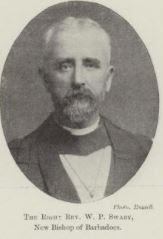
St. Mark’s Church was built in the early 1870s in Sunderland’s Millfield section, a growing working-class area. The Rev. William Proctor Swaby came to the vicarage in 1881. Swaby’s story was interesting. He was raised by his mother, helping to support her by being a teacher in Tetney, their village in Lincolnshire. He went to university in Durham where he was a leading athlete and scholar and, finishing his studies, was ordained in 1871. His first parish was in the mining community of Ryhope. Since coming to Sunderland, Swaby was credited with establishing St. Mark’s as a “model parish.” He served on the Sunderland School Board and oversaw the Boys and Girls High Schools. He was a gifted preacher and much in demand. His sermons were published. His income amounted to about £800. So, why was his father on the dole?


In 1891, Rev. Swaby received a summons from the Shardlow Board of Guardians in Derbyshire asking why he should not contribute to the maintenance of his 70-year old father who was presently receiving outdoor relief in the village of Long Eaton. The vicar replied by mail declining the summons. He was, firstly, not satisfied the man called Joseph Swaby was his father. And, even if he was, why should he have to support a man who abandoned him as a child, leaving three boys and their mother? For more than 40 years, William had supported himself and his mother “without the least assistance” from his missing father.

This “remarkable and romantic story” received a good deal of attention. The Rev. Swaby, of course, would have to come to Derby County Hall to confront the guardians. He was the last of his family, as far as he knew. Both his brothers were dead. His mother was dead and she'd always told him that his father died of the cholera in 1846. Until this summons, Swaby had no reason to believe otherwise and had made no effort to find his pater. 

At the hearing, an elderly Tetney man swore to Joseph Swaby’s identity. Then, the prodigal father took the stand. He was born in Tetney, trained as a joiner. In 1846, he went to Grimsby to find work. He never returned. His wife, Rebecca, “preferred” another man, so he left her with him. For a while, he followed his son’s clerical career but had lost touch. Then, he saw a newspaper report about a sermon given by a Rev. Swaby in Tetney and he knew that had to be his son. When a guardian challenged him for not making any effort to contact his son or family for more than forty years, Swaby answered, “It doesn’t matter now.”

The elder Swaby, the guardians also learned, had re-married; his second wife was only in her 30s, and they had three children! While his step-mother et al were not the Rev. Swaby’s concern, his father was, the board decided. The clergyman would have to contribute 1 shilling, sixpence per week (less than £4 per year.) The guardians wanted to make clear that they did not hold the Rev. Swaby responsible in any way for his father’s plight. “There never was a prosecution in which the accused succeeded more effectually in clearing himself from unworthy aspersions.”

There was no happy family reunion. The Rev. Swaby returned to Sunderland, sending his weekly payments. In 1893, he left England, accepting the appointment as Colonial Bishop of British Guiana. In Derbyshire, the public was informed that “the Bishop will continue to contribute weekly towards his father’s support.” How long the payments continued cannot be known but Joseph Swaby lived another 15 years. The Rev. Swaby remained abroad; he died in 1916 soon after being appointed Archbishop of the West Indies. 

How the Vicar Came and Went is the new collection of Victorian Clerical Errors and is available exclusively from amazon.co.uk.  

Rev. Swaby's photo copyright The Bridgeman Collection.